AI is changing how work gets done faster than boards can see it. Most committees still review the workforce in silos, a few times a year, looking backward. Yet the workforce sits underneath nearly every decision a board makes, and for most companies it is the largest controllable cost and the biggest constraint on the plan.
That was the starting point for the session we recently led with Directors' Academy at the Boardroom of the Future Forum at Arizona State University. This piece shares my part of that conversation: what we are hearing from directors, what good could look like, which metrics are worth a board's attention, and the questions directors can take into their next meeting.
Workforce sits under every board decision
Three recent board conversations show how often a strategy question turns out to be a people question.
A restaurant company planning to grow 50% over seven years. The strategy is clear and the capital is there. The question the board keeps returning to is whether the executive team can scale, and whether the leaders below them can too.
A company that grew 50% through acquisition. On paper the deal works. In practice, the board needs to know whether two cultures and two leadership benches can come together fast enough to execute the growth plan.
A bank where AI is starting to change how work gets done in operations. The board wants to know which roles change first, what that costs, and whether the workforce is ready.
Three industries, three different situations, one shared dependency.
Directors already feel this. In research from the Private Directors Association and Arizona State University, workforce ranked as the number two challenge boards face, ahead of AI at number three. Committees are also taking on more of it: 51% of S&P 500 companies now say their compensation committee owns human capital, up from 25% in 2021, according to EY.
The gap is that committees have taken on responsibility faster than they have built ways to see what is happening. One director put the need well: boards need more transparency and more dynamic flows of information, so they can bring their wisdom to management in a way that is appropriate. Nose in, fingers out.
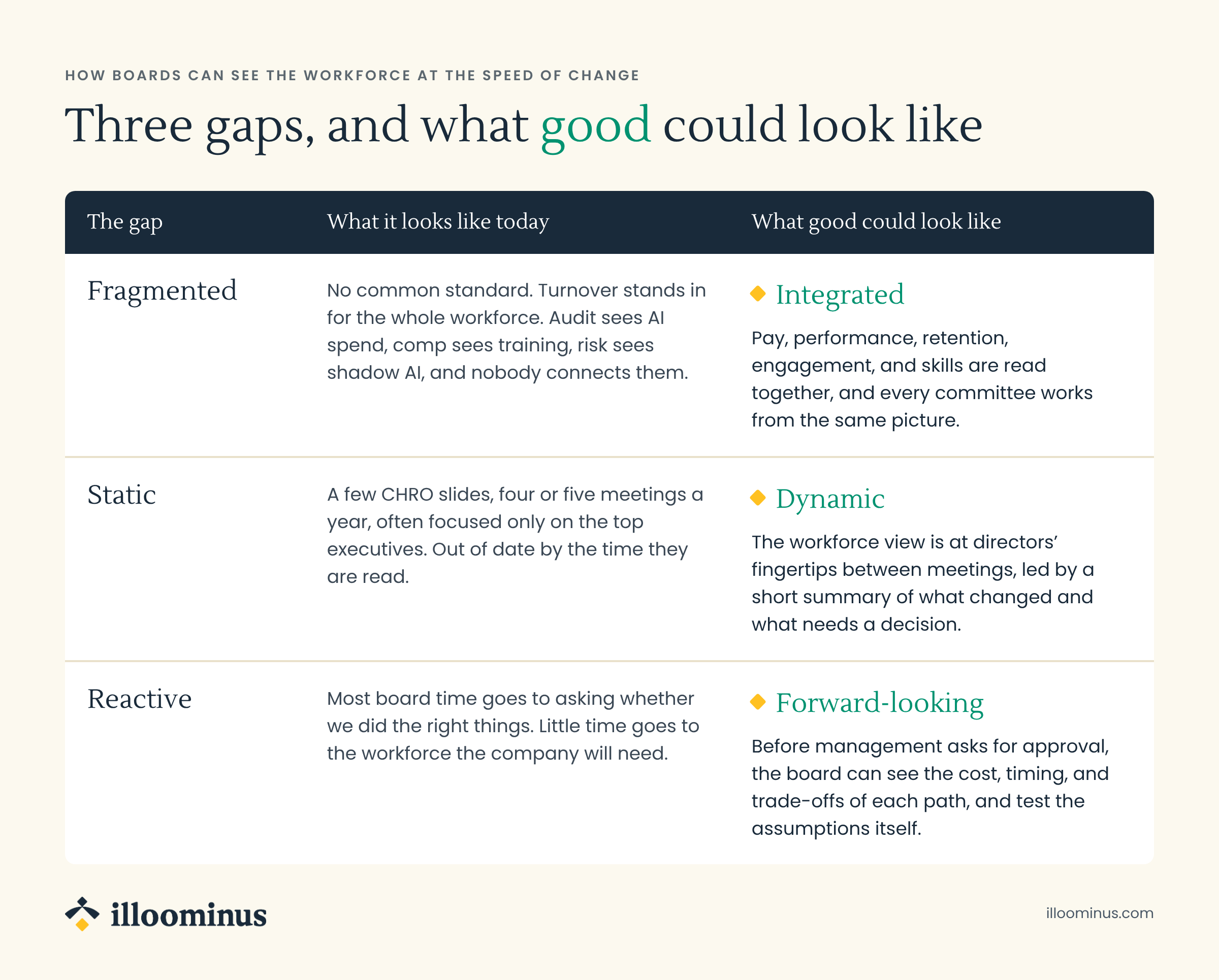
Three gaps in how boards see the workforce today, and what good could look like.
Picture what that means in practice. You open your pre-read, and the first page tells you what changed and what needs a decision. You can see whether the leaders below the executive team are ready to scale. You can see whether your people are ready for AI, beyond whether they have the tools. And when management brings a restructuring or reskilling plan, you have already seen the options.
The goal is earlier, clearer insight, so directors can bring their judgment to management while it still matters. More data on its own does not get there.
What boards should actually measure
The most useful approach we have seen is a small core set of metrics the board sees every quarter, plus one or two rotating deep dives as the calendar requires. Fewer, better metrics with context beat a long dashboard.
There is no required standard for board-level workforce reporting today. ISO 30414 is the closest thing to one. The second edition, published in August 2025, adds auditable requirements alongside recommendations and sets a baseline of 14 required metrics for organizations of any size. It keeps 11 human capital areas as its organizing frame, from workforce composition and costs to skills and development. Few boards will report against it formally, but it is a practical checklist for spotting what your board never sees.
Research on effective boards points the same way. WTW's guidance for boards, published through the Harvard Law School Forum on Corporate Governance, finds that effective boards favor simple, outcome-based metrics tied to business priorities, and ask for context such as historical trends and market benchmarks. Typical board dashboards cover workforce demographics, turnover, leadership succession, engagement, and compensation and benefits. More boards are now adding skill gaps, pay and career equity, and wellbeing.
Using those 11 areas as a frame, here is the core set we would suggest a committee start from, and what each one tells a director.
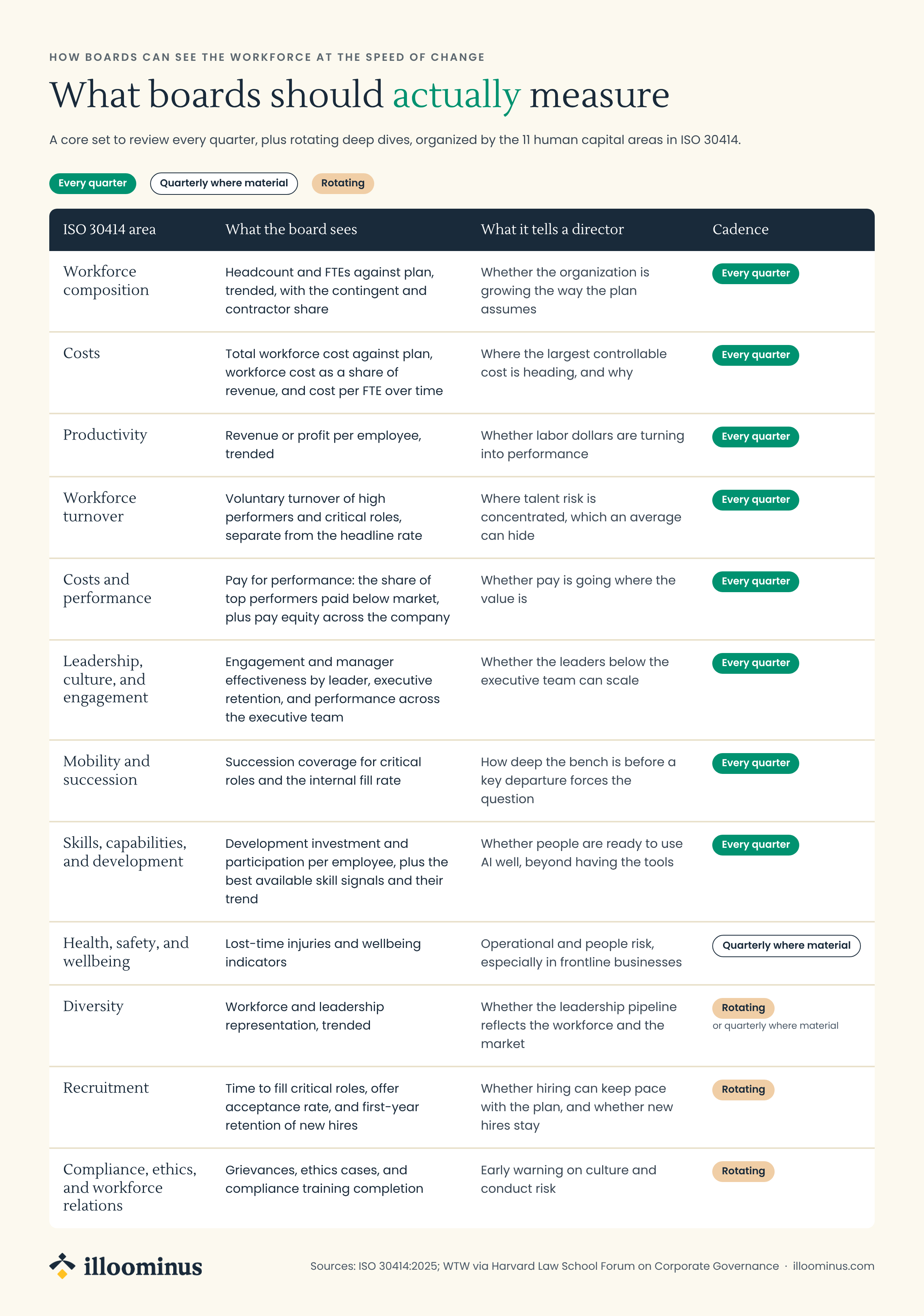
A core set of workforce metrics for boards, organized by the 11 human capital areas in ISO 30414.
A few practices make any of these metrics more useful to a board:
Show the trend. A single number tells a director very little. The same number with several months of history and a clear direction is something they can act on.
Add context. Compare each metric to the plan, to the company's own history, and to peers where a benchmark exists.
Look for concentration. An acceptable total can hide a function with high attrition or a critical role with no successor.
Lead with what changed. Open with a short summary of what moved since the last meeting and what needs a decision, then the detail.
Be honest about what is hard to measure. Skills like judgment and critical thinking have no perfect measure yet. Show the best signals available and how they are trending.
Protect individuals. Board views should be aggregated, with small groups suppressed.
Questions to take to your next board meeting
Nobody has this fully figured out yet, including us. These are the three questions we framed the session around, and they are a good place to start with your management team.
How are you thinking about AI Org Readiness? A strong answer covers people as well as tools: where the workforce stands on skills like context and judgment, who is building them, and how far below the leadership team development reaches. The skills, leadership, and succession metrics above are where the evidence lives.
How are you thinking about the payback on Reskilling? A strong answer treats reskilling as an investment with a cost, a timeline, and a payback. It also shows how reskilling compares with hiring, redeployment, and natural attrition before the board is asked to approve a plan.
How are you thinking about the return on your AI investment? A strong answer connects AI spend to workforce capability and productivity, and can tell whether a shortfall comes from the technology or from people's ability to use it well. It should also name which committee owns that link, and how the board would know between meetings if the picture shifted.
Nose in, fingers out
None of this asks boards to run the workforce. It asks them to see it clearly enough, and early enough, to ask the right question at the right time. Directors in the room at ASU brought far more experience than any one perspective, and the best ideas came from what they shared about their own boards.
We would like to keep learning from that. If your board has found a way to see the workforce that works, or you feel most blind somewhere we did not cover, I would love to hear about it.
Sources
ISO 30414:2025, Strengthening Human Capital Reporting and Disclosure, ISO/TC 260, August 2025
Why Boards are Focused on Human Capital Governance and Risk, WTW via the Harvard Law School Forum on Corporate Governance, October 2024
Private Directors Association and Arizona State University, board challenges research (link to add)
EY, S&P 500 compensation committee oversight of human capital (link to add)
About Illoominus
Illoominus is an AI-native workforce intelligence and decision-support platform. It brings together HR, finance, and operational data with external benchmarks, surfaces what changed and what needs attention, and helps leaders make better decisions faster. Executives and committees use it to see workforce cost, risk, and readiness in one place, with scenarios that show the cost and timing of decisions before they are made.
See it in action with live data. If you want to see what a forward-looking workforce view could look like for your board or leadership team, schedule time with our team.