Workday vs Visier vs Illoominus: Which People Analytics Platform Is Best for Mid-Market Companies?
Organizations today collect more workforce data than ever before.
Recruiting metrics, engagement scores, attrition trends, compensation data, performance ratings. The list keeps growing.
But most HR teams are not struggling to collect data. They are struggling to turn that data into clear decisions leaders can act on.
When companies start evaluating people analytics platforms, the real question is usually:
How can we get actionable workforce insights without building a full analytics team to support it?
This question is especially common among mid-market organizations with 500 to 5,000 employees. These companies need strategic workforce insights but often do not have large internal data teams.
Three alternatives that frequently come up in this evaluation:
Workday Prism Analytics
Visier
Illoominus
Each platform solves a different problem. Understanding those differences is critical before making a decision.
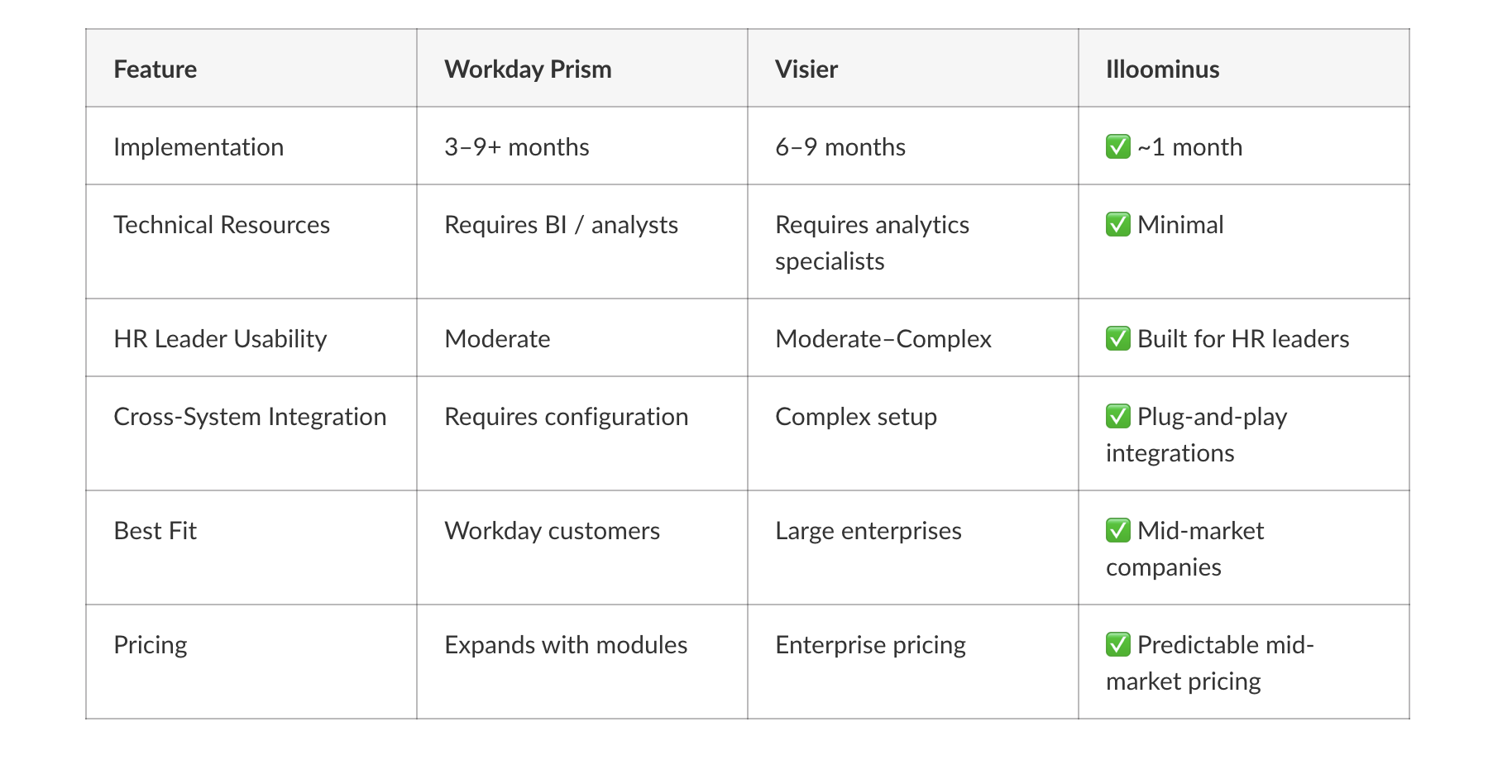
We’ll compare Workday vs Visier vs Illoominus across key areas including implementation, usability, cost, and the types of organizations each platform serves best.
Workday Prism
Best for: Companies already standardized on Workday that have internal reporting or BI support.
Workday offers built-in reporting capabilities within its HRIS platform. Because many organizations already use Workday to manage HR data, reporting inside Workday is often the first step toward workforce analytics.
Workday can generate reports on metrics such as:
Headcount
Hiring activity
Compensation
Organizational structure
Workforce changes
For operational HR reporting, this can be very effective.
Strengths of Workday Analytics
Native reporting inside the Workday ecosystem
Strong governance and structured HR data
Useful operational reporting for HR teams
Familiar environment for Workday administrators
Limitations Many Teams Encounter
While Workday is excellent as a system of record, many organizations find that deeper analytics for Prism requires many additional layers.
Companies frequently need to add/ roles tools such as:
1-2 analysts to run the system
BI platforms like Power BI or Tableau
These additions can introduce challenges such as:
Reports that require technical expertise to build or maintain
Difficulty analyzing data across multiple HR systems
Limited flexibility for HRBPs and business leaders who want self-service insights
Increasing costs as more analytics tools are added
Workday works best as a data foundation, but many organizations still need another platform to transform that data into strategic insights.
Visier
Best for: Large enterprises with established people analytics teams.
Visier is one of the most well-known dedicated people analytics platforms. It is widely used by large organizations that want advanced workforce analysis and benchmarking.
Visier provides structured dashboards and analytics across areas such as:
Workforce planning
Attrition analysis
Diversity metrics
Compensation analysis
Talent pipeline reporting
Large organizations often use Visier to deliver workforce insights to executive leadership or boards.
Strengths of Visier
Extensive library of workforce metrics
Strong industry benchmarking capabilities
Workforce modeling tools
Executive-level dashboards and visualizations
Challenges for Mid-Market Organizations
Visier was designed primarily for enterprise environments, and that can introduce complexity for smaller organizations.
Common challenges include:
Longer implementation timelines due to complex data integration
Ongoing technical ownership required to maintain data pipelines
Training required before HR leaders can self-serve insights
Enterprise pricing structures that exceed the needs of many mid-market companies
Visier is powerful when a company already has a mature people analytics function managing the platform.
For companies still building their analytics capabilities, the platform can feel heavier than necessary.
Illoominus
Built for: Mid-market HR teams that need workforce insights without enterprise complexity.
Illoominus was designed specifically for companies that are growing quickly but do not have large analytics teams.
Many mid-market organizations face common challenges:
Data spread across multiple HR systems
Manual spreadsheets used for reporting
Limited internal BI resources
Leadership asking more sophisticated workforce questions
HR teams spending hours building reports instead of analyzing insights
Illoominus focuses on solving these problems by delivering decision-ready workforce insights quickly.
Key Advantages of Illoominus
Illoominus provides a workforce intelligence layer that connects HR data and makes insights accessible to HR leaders and business stakeholders.
Key capabilities include:
AI-powered dashboards that surface insights quickly
Integration across multiple HR systems
Flexible workforce views by department or business unit
Self-service insights for HRBPs and leadership teams
Faster time to value compared with enterprise analytics platforms
Instead of acting as another HR system or complex analytics engine, Illoominus focuses on helping organizations turn workforce data into better decisions.
The Most Important Question in People Analytics
When evaluating people analytics software, the decision is rarely about which platform has the most features.
The better questions you should be asking are:
Do we have the internal resources to manage the platform?
How quickly do we need workforce insights?
Will HR leaders be able to access insights without technical support?
Are we paying for capabilities we will realistically use?
Because the real goal of people analytics is not building dashboards.
The real goal is helping leaders make better workforce decisions.
More about Illoominus:
Illoominus is a workforce insights platform designed to help HR leaders turn their people data into clear, actionable decisions. Using AI, the platform analyzes workforce data across HR systems to surface patterns, risks, and opportunities that might otherwise go unnoticed. With fast implementation, seamless integrations, and an intuitive interface built for HR and business leaders, Illoominus delivers enterprise-grade workforce intelligence without the complexity of traditional analytics tools.